






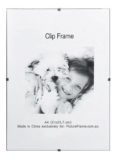
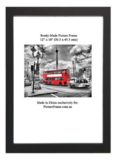
Ha! We got another AI picture frames online order stuff-up a few days ago. It was for poster frames, from a Customer from Eatons Hils in Queensland  and it was odd one. She had ordered four, A1 black glass frames with the note that the frames had to be "standard tea-towel size" for her textile collection. Apparently, Chap GPT recommended our product to her as perfectly suitable for her requirements. She even followed up her online order with a telephone call re-iterating how we had to follow the AI "tea-towel" instructions. The Customer was adamant that AI had "told her" that our A1 size frames were the best for what she wanted and that's why she'd ordered them. During the conversation, the fact that struck our Manager the most, was the absolute reliance and unquestioning obedience the Customer had placed at her AI recommendation.
When we advised that it would be best to cancel her order as the frames were all wrong for what she wanted them for and also, were impossible to ship, she became angry, adding how rude we were and fired back, how dare we not heed AI's advice!
That being said the order was not processed because we simply knew that it wasn't right for what she'd wanted it for and that we would have a dispute on our hand, something that we always try to avoid at all costs.
Where And Why AI Failed
That being said, let's take a closer look at the reasons why AI's recommendation was so egregiously flawed recommendation.
1) Our A1 glass poster frames are unshippable and Melbourne Customer Collect only. This is prominently stated in bold red text both at the product page and at the Shopping Cart pages.
Somehow AI either ignored or overlooked both of these warnings and recommended a product that could not shipped anywhere, let alone to Queensland.
2) All A1 frames suit the International ISO size of 59.4 × 84.1 cm. This size is much too large and nowhere near the standard or medium teat-towel size of either 45 x 60 cm or 50 x 70 cm for household or domestic use. Thus, AI failed to compute, or to recognize the obvious, and recommended unsuitable an size to the the user.
3) The Customer specified that the art that she wanted framed were tea-towels, or textile material. It is common knowledge amongst picture framers and in the in the picture framing industry that textile have to expertly stretched and mounted before being framed.
Once more AI appeared unaware and ignorant of this requirement and blithely went ahead suggesting to the Customer a product, or products, that would not work.
Our Conclusions On AI To Date
Aside the above incident with the Eatons Hills Customer, there have been several other phone calls and orders involving this new, AI-driven inquiries.
We find that AI seems incapable of correctly evaluating and matching the search criteria submitted by users to the available product specifications published online .
For instance, a box picture frame constructed from a 2 x 3cm moulding does not mean that there are 3 cm of depth available in the picture frame for object framing, yet AI recommends it to users for that purpose.
Additionally, AI is either inept or fails miserably for custom picture framing purposes because virtual mockups do not accurately match and combine physical colors with lighting, and physical assembly requires hands-on craftsmanship.
Kindred to AI, AR ( Augmented reality ) visual mockups also often fail with lighting and colour mismatch. These tools struggle to capture and combine the true colors of mats, wood frames, and artwork under different room lighting.
Many are the Customers that do not want a bright white window mat but an off white or beige and AI often inaccurately illustrates these.
Another issue we encountered was that Customers were misled by AI's depth and scale renditions. While it seems to render flat, even projections and mockups well enough, it fails to correctly or realistically and depict or simulate physical nuances such as 3-dimensional effects or shadow-box depths required by many users, collectors and artists.
Also found badly lacking were the print resolution scales, the accuracy of color the RGB and CMYK profiles as well as missing altogether the necessary bleed margins needed for physical printing and, occasionally picture framing matwork calculations.
It's important to note that AI, AR and other similar or allied platforms cannot deploy automated intelligence agents for physical operations such as glass cutting, moulding cutting, mounting, fitting-up and conservation framing and these have no robotic equivalents, substitutes or alternatives.
Our conclusion to date, is that AI has insufficient, or little understanding, of the materials used for and in picture framing it cannot compute the physical constraints or chemical interactions of framing materials, such as how an acidic backing board might damage delicate or vintage artwork over time.
In particular, the purely human craft of custom picture framing relies entirely on human skill, ingenuity and precision, rather than automated technology.
One last observation we need to make is that we are seeing an increase in visitors contacting us with their AI-planned work templates for near-impossible, complex, delicate and elaborate, shadow-box, object-framing projects.
These difficult, complex and highly specialized framing projects often involve large, heavy or delicate 3-dimensional objects such as swords, rifles, uniforms, wedding veils, baptism or christening dresses, all designed and pre-planned with AI.
They sometimes visit us carrying their iPads, excitedly showing us the detailed, planned and exacting sketches of their complete projects to the point of even specifying the precise colours, the exact sizes, the select materials and the completion deadlines.
Unrealistically, they also expect the cost to be somewhat similar to that of same-size, cheap, mass-produced, ready-made, department store frames. One such memorabilia project we costed at $635 dollars the visitor told us that ChatGPT priced it at approximately $138.
Summing it up, all these AI failures tend to generate both user and Customer disappointment as the final physical product often looks different from the digital screen preview, leading users and Customers to abandon these programmes.
The Do's And Dont's In Using AI For Picture Framing.
| List of Do's | List of Don'ts | ||
| ✓ | Do keep it simple. Don't quiz AI on how to mount a painting for instance. The different methods, techniques and materials that may or may not be successfully used can be a challenge even for experienced picture framers. | ❌ | Don't task it to plan or work out object-framing for you. AI doesn't compute depths, spaces and clearances too well. We have stopped Customers from ordering products which AI incorrectly recommended. |
| ✓ | Do use it with caution, especially in conjunction with acid-free or archival picture frames, methods and materials. If quizzed mainly about cost, AI may suggest commercial, mass-produced picture frames, generally not at all suited for these specific purposes. | ❌ | Don't ask it how to frame pastels. For instance, AI will tell you not to spraying fixatives, yet this is the only reliable way to fix and stabilize this highly friable medium. Our framers cannot frame this art unless it is sprayed first. Unless this is done, Customers will come back later on complaining that their art's window mats have become dirty, dusty and soiled. |
| ✓ |
Do use it for researching or converting Imperial to Metric measurements as well as national sizing conventions. It will probably locate and explain esoteric sizes such as the Japanese Nakazuri and English Double Crown formats. |
❌ |
Don't rely on artificial intelligence for advice on how to hang art. It suggests that you can hang picture frames securely, and without nails, by using heavy-duty self-adhesive strips like Picture Hanging Strips. Yet, at least once a week, a Customers will bring in to us a broken frame for repairs that fell of the wall after falling off from these hangers. We actually refuse to stock, sell or recommend any self-adhesive, hanging products. |