





 It's not often that we actually witness an utter, complete, if past,
  catalogue of picture framing disasters all framed within one picture frame, but recently we came across one. A young lady recently came to us with a pair of late, 18th-century Venetian pen and ink, framed drawings inherited from her grandmother. She liked them, she knew that the frames were damaged and that the framing was sub-standard and commissioned us to reframe the works, which we did, to the required, acid-free standard. We decided that this re-framing commission would be ...
Blog and Guides
We have been picture framing for a long time, since the late 1970's. Back then, Malcom Fraser was our Prime Minister and 200,000 or more Asian migrants and boat people were settling here, helping to make Australia multiracial and multicultural.
That was a long time ago. In those days, the picture framing industry was seasoned, robust, healthy and growing all the time. Now, around half a century later, our once thriving industry is pitifully decrepit.
It is in fact, moribund, impotent and almost infirm. This decrepitude is not due to ageing or industrial ineptitude. Rather, it slowly became thus because of continuous global, technological, economic, political events and circumstances beyond its ken and control.
By and large, the competitiveness engendered by the internet, the dismantling of import duties and tariffs, and our high domestic wages, disproportionate to those of our leaner, meaner and hungrier competitors overseas, all contributed to the slow strangulation and destruction of our local industry.
Sure, there are still isolated, scattered, tenacious survivors, like ourselves, but your local street, or shopping centre picture framer has pretty much disappeared. This is because, and in the main, our Customers find our locally-made products and services far too expensive. Alas, we have outsmarted ourselves.
We kept ( and still keep ) awarding ourselves such high wages and increasing them for so long and so often that now, most Customers cannot afford custom picture frames and our framing factories have all closed down. Vale, Australia Picture Framers!
Nevertheless, and during all these years, experiences were gathered and lessons learnt, about picture frames, picture framing and our industry, such as it once was. Rather than forsake these rich legacies of small business and suburban manufacturing histories to become unremembered and be forgotten, we have retrieved and curated these here, under the mantle of this News Blog of posts, or blogs. Enjoy!
A.I. + Picture Framing = Disaster
Posted on Category: Buying GuideBy:Ha! We got another AI picture frames online order stuff-up a few days ago. It was for poster frames, from a Customer from Eatons Hils in Queensland  and it was odd one. She had ordered four, A1 black glass frames with the note that the frames had to be "standard tea-towel size" for her textile collection. Apparently, Chap GPT recommended our product to her as perfectly suitable for her requirements. She even followed up her online order with a telephone call re-iterating how we had to follow the AI "tea-towel" instructions. The Customer was adamant that AI had "told her" that our A1 size frames were the best for what she wanted and that's why she'd ordered them. During the conversation, the fact that struck our Manager ...
Alas, broken expectations ..
Posted on Category: Frame Types & StylesBy:In this post we will write of some failed, or broken expectations. Not necessarily about the big personal ones, but of the small, every day ones, 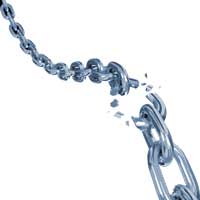 like the one you might naturally experience when you finish tying a steel wire to the back of a picture frame. You would rightfully expect the wire to hold, but sometimes it doesn't, and you end up with a broken glass, frame, or both. When this happens, Customers come to us to get their frames fixed telling us what happened. During these discussions, Customers ask us for our opinion as to which material, steel wire, or rope, is the strongest, safest and most durable to hang pictures with. Invariably, they will tell us that they know, that it's steel wire ...
Do I have to put My Canvas Photo Or Painting In A Frame And What Choices Do I Have?
Posted on Category: Frequently Asked Questions ( FAQs )By:
No, you don't only have put a canvas painting in a frame, you have other choices. The first choice, and most 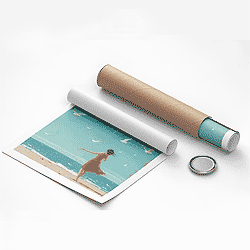 popular one is to stretch it over a strainer or stretcher frame. That means first making the frame and stretching your canvas over it tightly. That way you won't even see the frame as it'll be hidden inside the stretched canvas. The second choice is to mount or glue down your canvas art (only if it's an inexpensive or of no real value item) onto a board, just as you would a print or poster, and then put a picture frame around it. With this choice, most Customers choose not to have glass fitted to picture frames this tends to take away the feel and texture of oil paintings on canvas. The third choice is to combine the first ...
Best Unsung Hero Ever: The backing board
Posted on Category: Frame Parts & ComponentsBy:Why write about picture frame backing boards? Truth be known, we were scratching for ideas for this month's post. We asked the lads for suggestions for a new post but most told 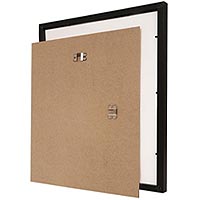 us that they felt that we must have written just about everything there is to know about picture frames. And that seemed to be so until someone asked about backing boards, had we ever written anything about them? The answer was in the negative, and do, here we go, let's discuss backing boards, the kinds used in picture framing to make picture frames. To begin with, and so far as the picture framing occupation is concerned, backing boards, backer boards, back boards, backs and and backings are all synonyms of the same ...
What Are The Differences Between Custom-Made And Ready-Made Picture Frames?
Posted on Category: Picture Framing Industry InsightsBy:
There are many differences between custom picture frames and  ready-made ones with the main one being the the price. Custom picture frames are made one at a time, normally with real, timber wood, not MDF, and better-quality materials, to exactly suit and fit customer's artwork. Importantly the labour, the the materials and the processes are more expensive and thus, the costs and prices will be higher. Ready-made picture frames or off-the-shelf frames, on the other hand, are produced in mass, almost invariably with cheaper, common-quality materials, to approximately suit most common or popular picture framing sizes. With custom picture framing, the picture framer carefully selects the components ...
Picture Framing For Jigsaw Puzzles
Posted on Category: Frame Types & StylesBy:
Making picture frames for jigsaw puzzles is part and parcel of everyday picture framing. Most experienced framers should  have no problems at all picture framing these reasonably quickly and economically. The cost of framing puzzles ought not be much more expensive than framing an ordinary prints because similar the same wet-mounting processes are used. The picture framer just needs to be careful not to tip, spill, drop, bump or upset the assembled jigsaw puzzle brought in by Customers, usually on flat boards or cardboard sheets. Some Customers are aware of the inherent instability of their newly-solve puzzles and attempt to stabilize them with masking ...
How much of a photo does the picture frame rebate hide, or cover up?
Posted on Category: Frequently Asked Questions ( FAQs )By:
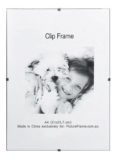
A picture frame's rebate ( or rabbet in the USA ) does not cover or hide from view a great 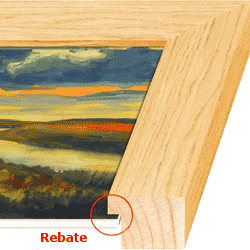 deal of the art being framed. Typically, it is be around 5 to 7 mm, depending on the moulding ( picture frame ) manufacturer. The circle in the accompanying illustration shows a typical rebate width and ensuing artwork coverage. This "covering" of the artwork normally occurs with all picture frames an photo frames and there are no simple or inexpensive ways to avoid it. Of course, one could use a clip frame, which not being a "proper" frame, has no intrusive rebate and therefore can display the entire artwork but clip frames are a very different product ...
About clear glass and non-reflective (non-glare) glass for picture frames
Posted on Category: Frame Parts & ComponentsBy:
Internationally speaking, in the glazing picture frames, there are 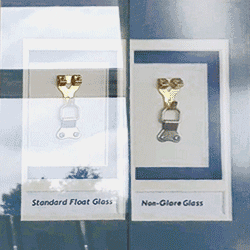 perhaps a dozen different types of glaze (meaning to cover a surface with a see-through or transparent cover) materials available, depending on where, or the various countries, where pictures frames are being made. Most are made of various kinds of glass and the rest being plastic, polyethylene boards, Perspex or just clear PVC sheeting. With regard to the glass glazing materials, the two major types of picture framing glass found in Australia, are clear float glass and non-reflective glass with the former being the commonest because it is the cheapest. Clear glass, however has two main disadvantages. Firstly it is quite reflective, and secondly ...
I’m from the U.S.A. and confused about the “A series” picture frame sizes, what are these?
Posted on Category: Frame Parts & ComponentsBy:
For generations, Anglophone countries, such as Australia, used the imperial system of measurements which 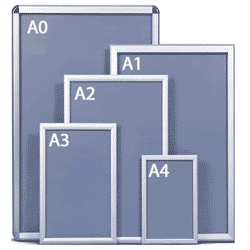 included feet and inches. In picture framing, for photo frames and picture frames, inches were the most commonly used unit of measure. So picture frames were known, made and sold in sizes such as 8"x10" , 11"x14, 20"x30", etc. Beginning in 1970, Australia metrication gradually supplanted the imperial system and large scale conversion across the paper, printing, photographic and allied industries industries such as picture framing began. There are many powerful reasons why ...