







To comfortably stretch a canvas over a strainer frame having 2 cm thick 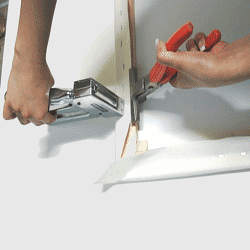 bars, a canvas margin of about 4 to 5 cm will be needed for sufficient gripping. The canvas is firmly gripped with with a pair of canvas pliers, pulled, held in position, and then stapled in place, as shown in the image here. If the stretcher bar is thicker, add this extra thickness to the above, recommended thickness. The margins of the canvas should have at least this width of all four sides of its sides. This goes for all canvases, whether gallery-wrapped or not. This margin width will allow for the wrapping of the canvas around and over the four sides of the stretcher frame bars. All for canvas margins must be pulled tightly and stapled evenly all around the perimeter, on all four sides to achiever flatness and tautness.
This is most important as we can think nothing is more unappealing and unprofessional than a poorly-stretched, pucky, wavy, sagging canvas. If the canvas cannot be tightly gripped, say, because of narrow margins, the tension is likely to be insufficient.
Should this occur, the canvas may "puck" or "sag" somewhere or anywhere on its surface and or sides. Such appearance, undesirable and unsightly, is often also a sign that an amateur or inexperienced picture framer, may have done the stretching.
This rational applies to both the hand-stretching and machine-stretching of canvases. It is to be noted the likelihood that most small to medium picture framing workshops will manually stretch Customers' canvases, rather than using a dedicated stretching machine.
How To Decide If A Canvas Can Be Stretched
\In the main, the above notes apply to brand new canvases painted with artists' oils. With tourists', or souvenir canvases, such as the ones many Customers bring back from overseas places such as Bali, there can be difficulties and complications.
When we consult with Customers about stretching canvases, the first and foremost thing we need to assess is not how to stretch a canvas, but rather, whether a canvas painting has been painted with and using professional artists' oils or acrylic, house paint instead.
Generally, artists all over the world aren't wealthy professionals, far from it, and this is even more so in poorer countries overseas. We are reliably informed that professional artists' oils cost four to six time more than acrylic, ceiling, or common house paint. Because of this, most of the Balinese paintings tourist bring back from Bali are painted in the much cheaper and common, acrylic house paint .
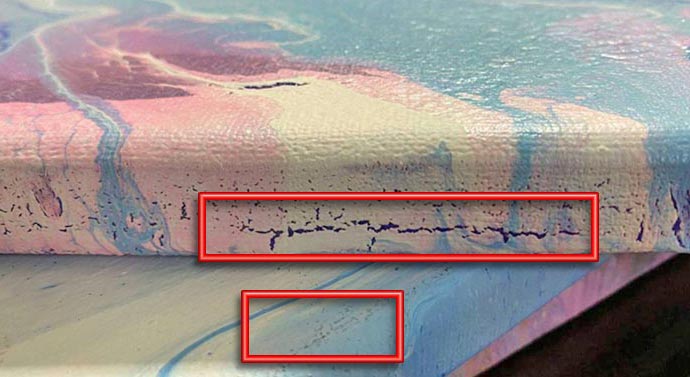
Visually, or first glance, that may not seem to make a lot of difference, but when it come to stretching the acrylic painting, the margins' edges tend to develop cracks and tears when pulled over with stretcher pliers for stapling.
And this is because, unlike artists' oils, acrylic paint is rigid, meant to stay flat and cannot bend when pulled, folded, or bent over the stretcher frame's bars. An example is shown below:
Thus, with regard to stretching acrylic canvases, often these cannot be safely stretched and we suggest instead to we-mount them and frame them normally. This is a viable alternative and cheaper that stretch-framing as there are less materials, as well as less picture framing labour involved.
And Some Advice On Re-Stretching Canvases
Yet another aspect of stretching canvases is the re-stretching of previously stretched canvases, which can pose disparate problems. Re-stretching is often requested by Customers who have brought back from overseas that were originally stretched, but then had them de-framed so that the loose canvases be rolled up into tubes in order to more easily bring the tubed art back to Australia. This is a very common occurrence.
Unfortunately, what sometime happens with tubed and rolled up canvases is that these can dry while rolled up inside the tube, even after a few weeks. We have actually seen several instances of canvases cracking when being unrolled and flattened by the Customers on our picture framing s counter.Cracking occurs in the middle as Customers try to flatten with the hands the rolled up curled up canvas. Again this curling happens because artists, when painting their canvases, tend to use use cheap, inflexible, acrylic house paint rather than the much more pliable and flexible professional artists' oils.
As to the the margins, and if these are wide enough, the canvas can be de-stapled, or taken off, and re-stretched, perhaps over a new stretcher frame. There are of course other reasons for a canvas puckering or sagging, such as the lack of corner or centre bracing, but often the main reason is inexperience in stretching canvases or in building a suitable stretcher frame.
If you are considering stretching the canvas onto the stretcher frame yourself you might also want to read this post about choices when framing canvases.
If instead you're going to give it to a picture framer to stretch it for you, you can ask the picture framer, during the picture framing consultation, if there are other Customer's stretched canvases already fished, that you could take a look at.
You could then look at some and discuss their appearance with the framer. He or she should not mind discussing this aspect with you. If this happens, you might consider consulting a more helpful picture framer.
That said, it is quite difficult to successfully stretch a canvas unless there are four, sufficiently wide, overhanging margins, so make sure you have those before you consider stretch-framing!
What To Do and Not To Do with Stretching Oil Paintings
| List of Do's | List of Don'ts | ||
| ✓ | Do smell a canvas painting before buying it. If it smells "oily" then it's likely to be a genuine oil painting. If there's no smell, chances are that it's an acrylic painting which might be difficult to stretch without cracking. | ❌ | Don't haggle too much over price with overseas artists when buying their artwork. The might sell you their cheapest canvas rather than one of their best. |
| ✓ | Do be aware that stretching and float-framing a canvas painting is expensive because two frame will be needed. One is the stretcher or strainer frame, the other a float fame. | ❌ | Don't keep a canvas rolled up in a travel tube, or anywhere, for any length of time. The canvas may dry in a tubular shape and be impossible to stretch later. |
| ✓ | Do keep in mind that conventional framing is always cheaper than the above option. This is because one frame will need toe ba made, instead of two. | ❌ | Don't demand that a canvas be stretched if the picture framer expresses concerns about the end result. Customers sometimes insist on the "stretcher" look even when cautioned about it and may be disappointed when sometimes the finish isn't as perfect as they expected. |
| ✓ | Do remember to remove rolled up canvases from their travel tubes after arriving home. Removing and placing them on flat surfaces will help avoid curling, cracking and maintain flatness. | ❌ | Don't expect that all canvases painted by all artists be stretched as soon as they're finished. With artists' oils, some of the white oxides can take as long as two years to cure completely. That means that some canvases can't be handled, much less stretched, until all the paints have fully cured. |
In my case for my Indian oil paintings I had problems. The oils were lovely but badly sized and stretched to start off with and tacked onto crooked frames which were taken off so that we could roll up the paintings and take them back to Australia with us, The problem was that the margins were all crooked. On on side there’d be 6 cms and the other sides there were 1, 2 and 4 cms. My picture framer said the only way to make stretch frames was to "come in" inside the paintings about 5 or 6 cms in each case. But that would have meant losing too much of the subject matter ( indian festival procession) so we ended up glueing the poster to thin boards and framing these with white frames. I must say this worked out nice and my paintings really look good. So, you don’t always have to stretch oil paintings over stretcher frames!
I tried stretching some painting i got from Vietnam a couple of years ago. They were a standard size so i was able to find a pre made stretcher frame but the margins for stretching were so small! I had about 10 or 15 mm to work with. The painting was also not square so it made it incredible difficult for amateur like myself to stretch. I tried but it came out horribly. It sagged in places and the sides just werent right. I wish i had read this article before hand as i was going in blind, im quite handy with my hands but this was a bit beyond me. I took it to a framer and he was nice enough to do it for me even though i made a mess of it and even ripped the margins a little. He said this wasnt a problem as he would glue it down. I was just happy he could do something with the mess i made. It looks so good on my wall and he did it all for like 120 dollars. Sometimes its just easier to get a professional to do it.
Yes, please visit our post “Should I really be getting get my souvenir Asian painting stretched and then framed? which not only discusses the stretching of canvases, but also the importance of having sufficiently wide margins for successful stretching.
This is a goldmine of sagacity and a treasure trove of wisdom for anyone tempting fate with DIY canvas stretching! The 4-5 cm margin rule is like the Golden fleece – essential, yet often overlooked until it’s too late. Those poor Balinese artists using acrylic house paint must weep knowing their masterpieces risk becoming puckered relics. And rolling canvases? Keep them flat they say, but life happens! Rolling is the new stretching taboo. While we chuckle at the amateur saggers, the true takeaway is clear: leave the stretching to the professionals, or embrace the unique character of a DIY job. It’s either perfect flatness or a charmingly wonky story. Choose wisely picture framing aficionados!