





 It's not often that we actually witness an utter, complete, if past,
  catalogue of picture framing disasters all framed within one picture frame, but recently we came across one. A young lady recently came to us with a pair of late, 18th-century Venetian pen and ink, framed drawings inherited from her grandmother. She liked them, she knew that the frames were damaged and that the framing was sub-standard and commissioned us to reframe the works, which we did, to the required, acid-free standard. We decided that this re-framing commission would be quite useful in informing the public on of the dangers of incorrect picture framing, hence this post.
The Litany of Errors
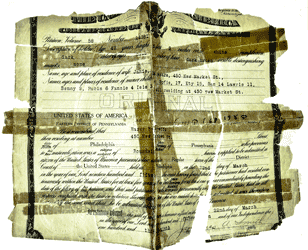
Now progressing, we publish below here a detailed photograph of one the two drawings, and under it, its legend, detailing the points we will discuss.

1) Acidic brown packing tape: Somebody, somewhere, at some point, decided that common, acidic, Kraft paper tape could be used to tape the artwork to its window mount. Alas, this is one very common and grievous mistake.
Kraft tapes are horribly acidic and the acid will transfer or migrate to whatever it is touches or it is adhering to, in this case, a beautiful centuries old, work of art. The acid contaminations, can be reversed in many cases but is is slow, skilled and delicate remediation work mostly undertaken by skilled art conservators. Since this remediation work is neither quick, simple, nor cheap, it is best prevented.
2 ) Incorrect tape hinging: The art was not hinged but merely strip-taped. Most probably it was not the work of a picture framer because such professionals are trained and experienced enough to know that the correct and preferred method of hinging is to make a "T "hinge. In addition an acid-free tape should have been used which was not the case here.
Straight, or strip-taping, instead of hinging can be quite damaging to art. This incorrect taping stops the taped art from expanding and contracting in response to ambient temperature. In extreme cases, with very delicate papers, strip-tapes has been known to actually break and tear delicate art held fast by continuous strip-taping.
3) Acidic residue: This starkly evident contamination occurred and was a result of undertaking step 2 ) above. Most acidic tapes leave layers of gum and adhesive when removed, all highly acidic. Acid-free tapes are designed not to leave any residue, and what little is left, is not acidic.
4) Acidic mount burn lines on artwork: The straight, brown rectangular lines on the artwork were caused by the bevelled, cut edges of the acidic mount. The acid contained in the wood pulp of the window mount migrated to the surface of the artwork contaminating it and and staining it.
5) Acidic window mount ( or window mat ): This picture frame component is often not recognised as harmful until it turns dark, or brown, and by then, it is too late. Brand new acidic mounts are virtually indistinguishable from acid-free ones and one has to rely on the information provided by the merchant or the re-seller to ensure that matboard sheets ( from which window mats are cut ) be acid-free.
6) Original artwork colour: Hidden under the window mount, the original colour of the drawing is shown as an off-white, being much lighter than the dark, main body of the drawing. The centre of the art has darkened considerably owing to the consequences of two harmful agents.
One was the acid migrating from the backing 9) to the drawing, and the other, the fading caused by the ultra-violet rays passing through the unsuitable clear glass, whereas Ultra-Violet resistant glass should have been used.
7) Faded, colour of artwork: The photograph shows the cumulative damage, over many decades, caused by the inappropriate glazing material. The ordinary, clear glass glazing that was fitted, permitted the majority of the ambient ultra-violet rays to pass through and into the art, thus fading it severely and irremediably.
8) Ephemeral masking tape sealed the back: Masking are amongst the cheapest of the cheap and rank with office stationery tapes as being the worst to use for picture frames and in picture framing. The main problem with them is that they're full acid and peel or fall off picture frame in a little as a few weeks, in other words, next to useless.
9) Acidic backing: Of all the noxious picture framing parts and components detailed in this post, this acidic backing was the worst of the worst. We found no acid-free board or barrier in place between the artwork and this backing. This omission, whether intentional or not, allowed for the continuous and unrestrained and continuous acid migration for decades from the cardboard backing and absorbed by the artwork.
10 ) Document pocket: Two bits of masking tape a document pocket do not make. When we make document sleeves or pockets we construct a proper, acid-free, mylar pocket, taped on all thee sides with acid-free tapes.
The above, sad litany of errors, can be easily,simply and cheaply prevented remedied by hobbyists, DYO amateurs, or anyone, who does his, or, her own picture framing.
The single, most important factor to remember is that, whatever touches the artwork to be protected, this item, material or component, must be, at the very least, be acid-free, and if the art warrants it, archival, and even conservation.
How To Remedy The Mistakes
To achieve the the minimum acid-free standard is neither difficult nor expensive. Firstly , and starting with the backing, acid-free foamboards are eminently suitable for this purpose and are easily available at our online store as well as most art stores. With these foamboards there are no acidic materials to contaminates the artwork with and thus, safe. For more information , visit below: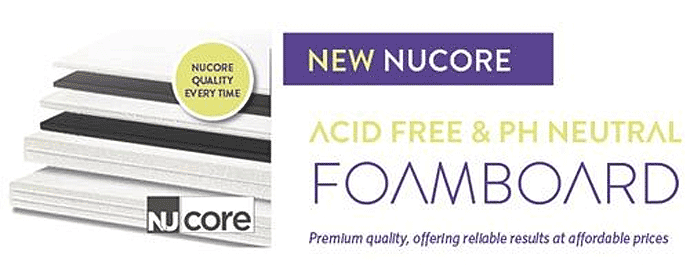
Another, and perhaps, just as important factor in preventing acid damage and acidic contamination is the total avoidance of acidic tapes. Even using a little bit of a cheap painting tape, stationery tape or packaging tape, is anathema to good picture framing practice.
These tapes are full of acid, reside and gunk and will damage any and all art even after a relatively short period of time as amply illustrated in the photograph above.
The root of the problem, if not the cause, seems to be that acid-free tapes are more expensive than the ordinary, run-of-the-mill tapes one finds in the home, office or workshop and most people tend to use those as it's cheaper, easier and quicker.
However it is definitely not the best to use in picture frames and picture framing. Therefore, do your art a huge favour, don't use unsafe tapes and do use safe, acid-free tapes!
How And Where To Buy Acid-Free Tapes
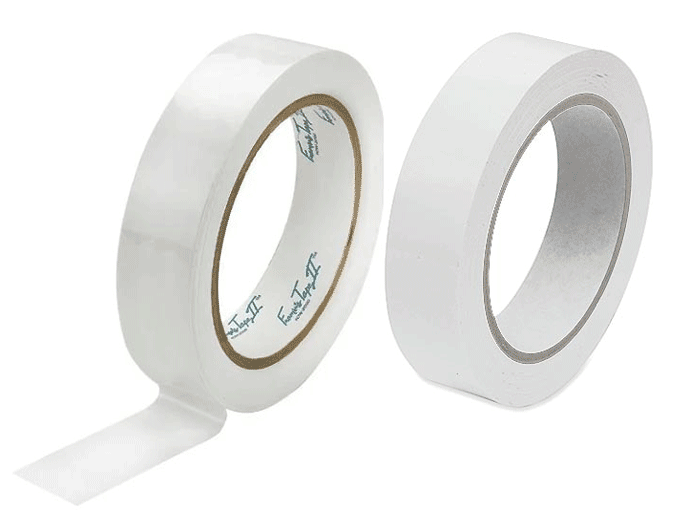
That being said, a very good, self-adhesive, safe tape that we ourselves have been using for many years, is Framer's Tape II below which we attest to be excellent value for money:
Still on the subject of self-adhesive picture framing tapes, it is always good practice to tape over and seal the back of all picture frames to prevent, if not avoid, insect intrusions inside photo frames and picture frames.
At the beginning, this may not seem much of a problem, but with the passing of time, it does become so. Nearly every framed work we have ever reframed showed us multiple signs of insect infestation.
For more detailed information on pests, please review one of our past posts: Picture frames pests, intruders and akin insectiferous invaders .
That being said, the tape that we recommend using as a sealing tape at the back of picture frame is our range of self-adhesive Kraft Paper Tapes with the most popular being the 36mm x 50m Picture Framing and Backing Tape .
It is important to bear in mind that taping the back of frames need not be an acid-free process mostly because the wood moulding of picture frames always and naturally includes acidic lignin which is not removed in the manufacturing process.
Moulding rebates can be sealed with special, acid-free rabbet ( or rebate ) tapes acidic but this method involves the higher and more complex archival and conservation standards neither being the subject of this post.
Perhaps a last point to remember is the need for all picture frames to have some air circulation at the back of the frames. This is easily achieved if the bottom edge of a picture frame is not resting flat on its wall but slightly raised away from it.
To do this, adhere some self-adhesive, felt bump-ons, at the back of the frame. We always place at least a couple of these thick, bump-ons at the back of each custom picture frame we make for our Customers.

We encourage Customers to ask for some free ones if these accidentally get knocked off. It is also a good housekeeping practice to regularly check the rear or the back of all picture frames so as check for mould cobwebs, or insect infestations. Should you notice signs of any of these, consult your local professional picture framer.
Do's And Don't s Of Acid-Free Picture Framing
| List of Do's | List of Don'ts | ||
| ✓ | Do specifically request for conservation, or at the very least, acid-free options when framing art, documents, photos, or anything that maybe valuable to you. That way you can ensure minimal, if any at all, art degradation or deterioration. | ❌ | Don't be cheap. Buy yourself a roll of genuine,acid-free tape when hinging or doing other taping work with you art and window mats, even if it costs more than packaging tape. Your art won't get and look burn, stained, soiled or fall out of its window mount. |
| ✓ | Do ask for Ultra-Violet Protection glass when requesting framing for any item which is dear, or valuable, to you. Without this specific glazing, all art will noticeably fade in as little as a few months. | ❌ | Don't cut corners if doing your own picture framing. Buy proper acid-free mounting or backing boards for the rear of the artwork or picture frames. Avoid at all cost using cardboard, newspapers or plywoods. All are highly acidic and will contaminate you art with harmful and destructive acids. |
| ✓ | Do yourself a favour. Stick a couple or bump-ons or felt pads at the back of your frames for ventilation when hanging them up. This does helps in avoiding the colonisation and breeding of unwanted spiders and other insects, all feasting on your picture frame backings. | ❌ | Don't trust fishing wire if re-hanging picture frames. People tend to use what's at hand when replacing a hanging cord or wire at the back of the frame, but fishing wire will not bear prolonged strain. It will fail, break after a period of time and the picture frame will end up damaged or broken on the floor. |
Thanks for this interesting and useful post Paul! Much appreciated! Also thank you for your time yesterday and answering all our questions regarding acid migration, unsafe materials, acid-free materials and safe tapes! -Mark and Maria.
I found this content educational and very useful towards my own personal picture frames gallery.