





 Why write about picture frame backing boards? Truth be known, we were scratching for ideas for this month's post. We asked the lads for suggestions for a new post but most told
 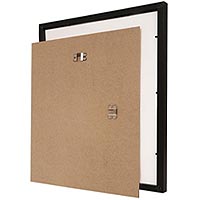 us that they felt that we must have written just about everything there is to know about picture frames. And that seemed to be so until someone asked about backing boards, had we ever written anything about them? The answer was in the negative, and do, here we go, let's discuss backing boards, the kinds used in picture framing to make picture frames. To begin with, and so far as the picture framing occupation is concerned, backing boards, backer boards, back boards, backs and and backings are all synonyms of the same ...
About clear glass and non-reflective (non-glare) glass for picture frames
Posted on Category: Frame Parts & ComponentsBy:
Internationally speaking, in the glazing picture frames, there are 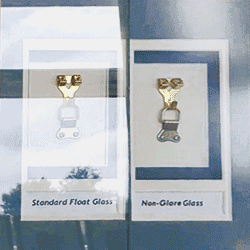 perhaps a dozen different types of glaze (meaning to cover a surface with a see-through or transparent cover) materials available, depending on where, or the various countries, where pictures frames are being made. Most are made of various kinds of glass and the rest being plastic, polyethylene boards, Perspex or just clear PVC sheeting. With regard to the glass glazing materials, the two major types of picture framing glass found in Australia, are clear float glass and non-reflective glass with the former being the commonest because it is the cheapest. Clear glass, however has two main disadvantages. Firstly it is quite reflective, and secondly ...
I’m from the U.S.A. and confused about the “A series” picture frame sizes, what are these?
Posted on Category: Frame Parts & ComponentsBy:
For generations, Anglophone countries, such as Australia, used the imperial system of measurements which 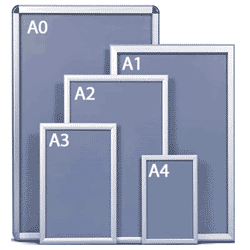 included feet and inches. In picture framing, for photo frames and picture frames, inches were the most commonly used unit of measure. So picture frames were known, made and sold in sizes such as 8"x10" , 11"x14, 20"x30", etc. Beginning in 1970, Australia metrication gradually supplanted the imperial system and large scale conversion across the paper, printing, photographic and allied industries industries such as picture framing began. There are many powerful reasons why ...
Mounting boards versus Mat boards explained
Posted on Category: Frame Parts & ComponentsBy:Like all occupations and professions, picture framing has its own specific terms, vocabulary, 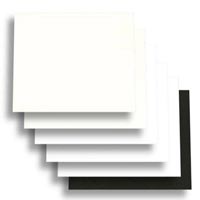 taxonomy and nomenclature. This is not surprising considering that one of the oldest picture frames ever made was found in Egypt and is thought to date back to at least 2,500 years ago. So far as Australia goes, at least some, picture frames, picture framing workers and artisans first arrived to Australia with the coming of the 1st Fleet in way back in 1788. Inheriting from the traditions of the mother country, Australians both borrowed and inherited the British picture framing vocabulary form the old country. One of these was the locution of a specific component of a picture frame, namely the ...
The Cheap Plastic Glass Fallacy
Posted on Category: Frame Parts & ComponentsBy:We have been picture framing for close to half a century and we have come across much disinformation and many fallacies where custom picture  framing is concerned. Perhaps the most persistent fallacy is the widespread and popular misconception that glazing ( the covering of framed artwork with a transparent or see-though material ) with 'Plastic Glass', 'Perspex' , 'Plexiglass', a clear plastic, or an acrylic pane is a cheaper more convenient and better alternative than glazing with clear float glass. Alas, and in our lengthy and not inconsiderable experience ...
I’m European and confused about frames in “inches”, what are these?
Posted on Category: Frame Parts & ComponentsBy:
In order to buy the correct picture frame for that print or photo you that have, you will need to know what its size it is first. A nd to know what size it is, you'll have to measure it even if these are in "inches" frame sizes instead of the more familiar, centimetres. Thing is, if you're from Europe, schooled and grown up with centimetres and decimetres, you would always have measured everything in decimetres, centimetres or millimetres. So when you go to buy and look for photo frames or picture frames, and you find a lot of them still labelled in Imperial sizes such as 8"x10" or 11"x14", chances are that you'll be a little confused. After all Australia is supposed to be a metric country, right, so what's going on? ..
What’s inside a picture frame?
Posted on Category: Frame Parts & ComponentsBy:
Yes, " What’s inside a picture frame? is one of the questions we get asked fairly frequently. The wordin g of the question can change from person to person but Customers want to know the same thing. And this is because they are curious of the components of a frame and the names of the parts of a picture frame. We may get asked:“What do you put at the back?” , or: “What will you put my picture on?” and even: “Will you make something so that my picture won’t fall off?”, and so on and so forth. The reason this question gets asked is because people know that a thin piece of paper like a poster can’t hold up by itself and wonder what and how it is being ...
The shadow box deconstructed
Posted on Category: Frame Parts & ComponentsBy:We sell a fair few shadow boxes all over Australia and we find that most Customers  know what a 3-Dimensional Shadow box is, how it is made and what it can be used for. But once or twice a month we receive phone call inquiries from "newbies". These newcomers want to know what a shadow box is and can they use it to put what they want inside it. As these types of box picture frames are a little complicated, have multiple components with size limitations, clearances, depth limits, etc, it can be a little difficult to precisely explain and convey all these aspects to Customers on the telephone, hence this post. To begin with, we don't really know for sure how ...
Of window mat designs and proportions
Posted on Category: Frame Parts & ComponentsBy:
Most Customers with an interest or passion in home décor, and more particularly, the picture framing an d display of art on paper, such as photos, prints, posters and the like, will probably already know what is a window mat (or window mount or passé-partout as it is known in Europe) when researching window mat designs . However for those who may not be fine art aficionados, a window mat is paper or cardboard edge one often sees around many of the nicer photos or images. It creates a separate field of colour, definition and light, between the picture frame and the art itself. More prosaically, it keeps the glass off and away from touching the art ...
A brief guide of window mats and their openings
Posted on Category: Frame Parts & ComponentsBy:
A Brief Tour of Window Mats and Their Openings. In this blog we will try to shed some light on Window Mats 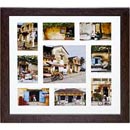 and Their Openings, with a particular focus to their external and internal sizing. A window mat ( Customers often call them edges, cardboards, surrounds, masks, etc ) or a window mount, as our English brethren would call one is that white or coloured cardboard that framers often put around images and inside picture frames. Broadly speaking, window mats are placed over and around images for several ...