





 It's not often that we actually witness an utter, complete, if past,
  catalogue of picture framing disasters all framed within one picture frame, but recently we came across one. A young lady recently came to us with a pair of late, 18th-century Venetian pen and ink, framed drawings inherited from her grandmother. She liked them, she knew that the frames were damaged and that the framing was sub-standard and commissioned us to reframe the works, which we did, to the required, acid-free standard. We decided that this re-framing commission would be ...
Blog and Guides
We have been picture framing for a long time, since the late 1970's. Back then, Malcom Fraser was our Prime Minister and 200,000 or more Asian migrants and boat people were settling here, helping to make Australia multiracial and multicultural.
That was a long time ago. In those days, the picture framing industry was seasoned, robust, healthy and growing all the time. Now, around half a century later, our once thriving industry is pitifully decrepit.
It is in fact, moribund, impotent and almost infirm. This decrepitude is not due to ageing or industrial ineptitude. Rather, it slowly became thus because of continuous global, technological, economic, political events and circumstances beyond its ken and control.
By and large, the competitiveness engendered by the internet, the dismantling of import duties and tariffs, and our high domestic wages, disproportionate to those of our leaner, meaner and hungrier competitors overseas, all contributed to the slow strangulation and destruction of our local industry.
Sure, there are still isolated, scattered, tenacious survivors, like ourselves, but your local street, or shopping centre picture framer has pretty much disappeared. This is because, and in the main, our Customers find our locally-made products and services far too expensive. Alas, we have outsmarted ourselves.
We kept awarding ourselves such high wages and increasing them for so long and so often that now, most Customers cannot afford custom picture frames and our framing factories have all closed down. Vale, Australia Picture Framers!
Nevertheless, and during all these years, experiences were gathered and lessons learnt, about picture frames, picture framing and our industry, such as it once was. Rather than forsake these rich legacies of small business and suburban manufacturing histories to become unremembered and be forgotten, we have retrieved and curated these here, under the mantle of this News Blog of posts, or blogs. Enjoy!
How To frame Indian Silk Paintings
Posted on Category: Frame Types & StylesBy: Ah! Indian Silk Paintings! We would be quite surprised if anyone did not know of them or about them. Certainly, we, as picture framers are well acquainted with these works of art, or at least, their facsimili. Bold, beautiful, elaborate, colourful, intricate and highly detailed, exuding, if not dripping, in and with timeless Muslim, Buddhist, Hindus, Muslim, Jain and Sikh traditions, folklore, fairy tales and storytelling . Alas, let's begin by the stating the obvious, Indian silk painting refers to paintings painted on silk, muslin, very thin cotton or cloth. The silk fabric, called Paat in eastern India, Pattu in southern India and Resham in northern part, is a natural, organic, fibre made from the mulberry silkworm ...
How Wide Do The Margins Need To Be For A Canvas To Be Stretched?
Posted on Category: Frequently Asked Questions ( FAQs )By:
To comfortably stretch a canvas over a strainer frame having 2 cm thick 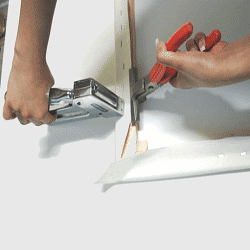 bars, a canvas margin of about 4 to 5 cm will be needed for sufficient gripping. The canvas is firmly gripped with with a pair of canvas pliers, pulled, held in position, and then stapled in place, as shown in the image here. If the stretcher bar is thicker, add this extra thickness to the above, recommended thickness. The margins of the canvas should have at least this width of all four sides of its sides. This goes for all canvases, whether gallery-wrapped or not. This margin width will allow for the wrapping of the canvas around and over the four sides of the stretcher frame bars. All for canvas margins must be pulled tightly and stapled evenly all ...
Buying Self-Adhesive Foamboards, a Users’ Guide
Posted on Category: Buying GuideBy:For decades, we have been making all sorts of picture frames and many 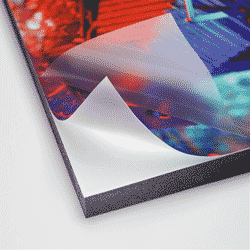 types of picture framing. And with that, we also did all methods of mounting. Broadly speaking this mounting process can be categorized as wet-mounting or dry-mounting, and in the latter category, self-adhesive foamboards, feature prominently. It's easy to know why. Properly used, these can offer clean, quick and easy permanent mounting in a matter of seconds. Mounting is more fully detailed and explained in our previous post " Picture framing wizardry and the secrets of mounting" but, basically, it means the bonding or glueing of artwork onto a flat surface so that the art stays and remains flat,
Do you repair broken picture frames and replace smashed photo frames glass?
Posted on Category: Frequently Asked Questions ( FAQs )By:
Yes we do repair broken picture frames and replace smashed photo frames glass, but with qualifications and 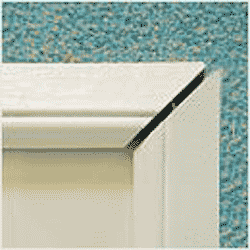 limitations. Picture frames repairs and re-glazing ( glazing is the covering of a surface with glass ) can be done by most picture framers provided the frame isn't too badly damaged or has just sprung open, as shown in the picture. Other repairs such as retouching of small scratches, replacing broken glass or decayed rear dust covers or broken cord, or string or hangers or nails or screws is also easily enough done. To repair or restore valuable, historical or antique picture frames which need restoration we recommend a qualified, professional art restorer, particularly when antique gilding or hand-carved mouldings ...
Do I have to put My Canvas Photo Or Painting In A Frame And What Choices Do I Have?
Posted on Category: Frequently Asked Questions ( FAQs )By:
No, you don't only have put a canvas painting in a frame, you have other choices. The first choice, and most 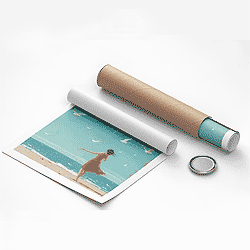 popular one is to stretch it over a strainer or stretcher frame. That means first making the frame and stretching your canvas over it tightly. That way you won't even see the frame as it'll be hidden inside the stretched canvas. The second choice is to mount or glue down your canvas art (only if it's an inexpensive or of no real value item) onto a board, just as you would a print or poster, and then put a picture frame around it. With this choice, most Customers choose not to have glass fitted to picture frames this tends to take away the feel and texture of oil paintings on canvas. The third choice is to combine the first ...
How can you ship or courier frameless glass frames and not have any clip frames breaking?
Posted on Category: Frame Types & StylesBy:
How? Simply put, because we have learned know how to pack them! When we first began shipping clip frames, we experienced  high breakages claim rates which, however, gradually decreased as our packing knowledge increased with time. In addition, we also learned that the the largest size glass clip frame we can safely ship is (A3 or 29.7 x 42 cm) after which, for the larger sizes, we changed to plastic glass glazing. Nevertheless, and in essence, we pack all glass clip frames with three layers of protective materials which reduces our to damages claim rate to about .01% . In the quite rare occasions that the glazing in the clip frames, photo frames, certificate frames or clip frames does break, we either refund the cost of the broken items or ship ...
How, Where and When to Use Tapes in Picture Framing
Posted on Category: Frame Care & MaintenanceBy:We were reminded of the importance of correct taping when a regular Customer brought in a valuable, antique, watercolour which had slipped and fallen out of its window mat. 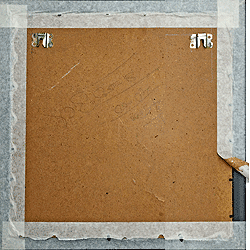 While at first sight that did not seem to be a great issue, we suspected ulterior problems. This is because, in our experience, expert, quality professional taping or hinging rarely fail. When this does happen, it's almost invariably due to the use of incorrect or inappropriate hinging or taping materials, methods, or both. This problem is exemplified by the image below. It shows art taped to a backing with at least four disparate self-adhesive tapes. One is a photograph corner, one a linen tape, one a tan masking tape and the last one, a double-sided tape application. All of them lack any archival ...
Trappist Picture Framing ? The Music Licence Scare
Posted on Category: Picture Framing Industry InsightsBy:What's this heading "Trappist Picture Framing ? The Music Licence Scare " all about, you might well wonder. Let us explain. "Trappist" refers to a branch of the Cistercian order  of Christian monks known for their rule and habit of silence. And the term "Picture framing" is common enough to be self-explanatory. So why the two terms together? This is because some dodgy, dubious folks tried to trick us into believing that listening to music while we worked was illegal, that we needed to buy their music Licence and that unless we did that, they would prosecute us, get us fined and even jailed. Now then, for those of you who are not in the industry, and thus ...
The Duty of Care Conundrum
Posted on Category: Picture Framing Industry InsightsBy:The motive for publishing this post conferring about the Duty of Care ( hereinafter abbreviated to DoC ) conundrum arose after yet another  incident at our factory outlet some weeks past. To begin with, let's describe the contretemps. A young couple visited our store wanting to buy four of our A2 Natural Ready-Made frames for the prints they had with them. We duly showed them the frames they were looking for, which, by the way, were glazed with clear glass, not plastic. The couple liked the frames and paid for them. They then blurted out that they were in a hurry and that they ...